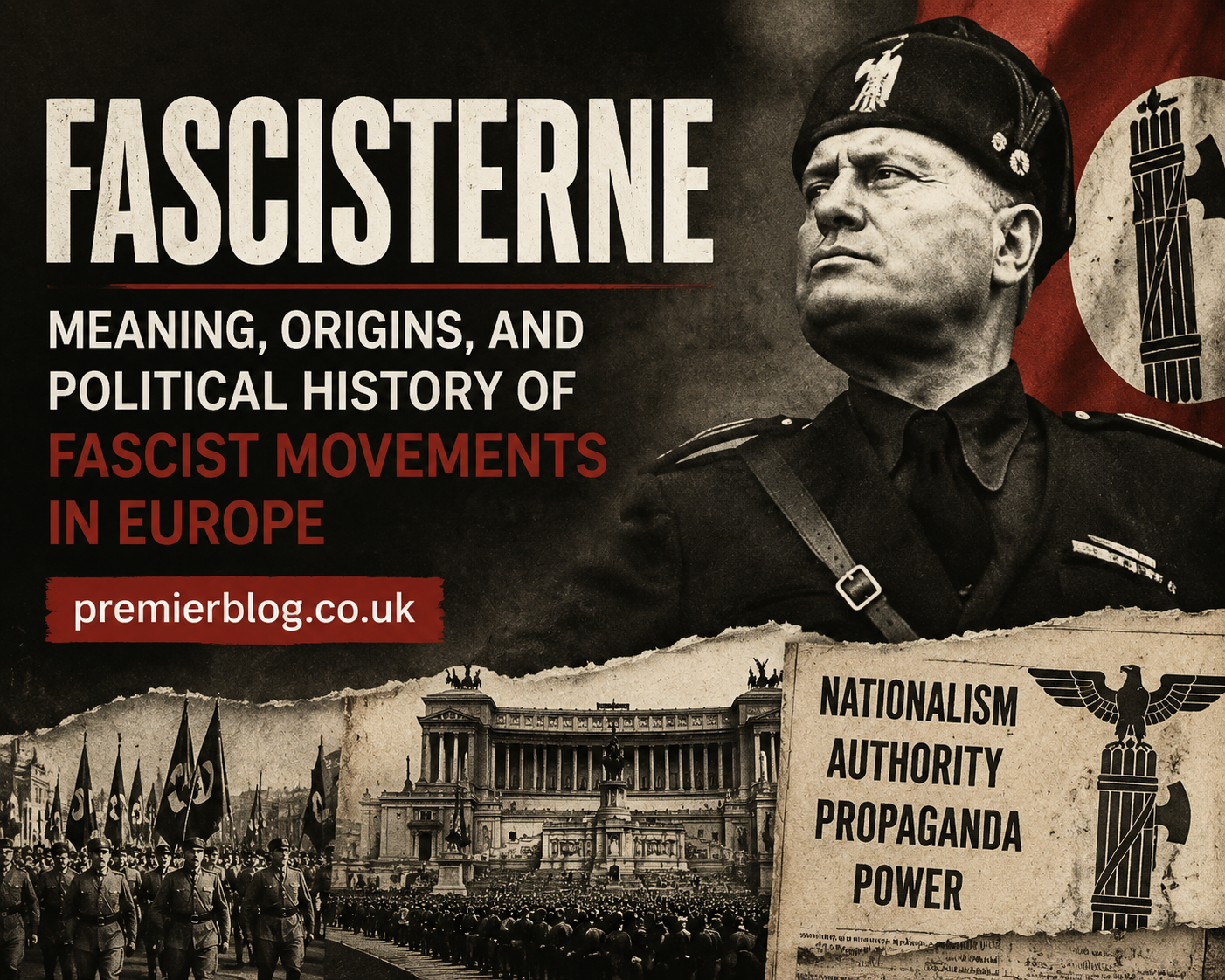
Introduction to Fascisterne
Fascisterne is a Danish word that translates into English as “the fascists.” It refers to people who support, promote, or belong to fascist movements. The word is often used in historical writing, political discussion, and public debate when describing groups connected with fascism, especially in Europe during the first half of the twentieth century. To understand the term clearly, it is important to look beyond the word itself and examine the political ideas, social conditions, and historical movements behind it.
The subject is sensitive because fascism is not just a political label. It is linked with dictatorship, political violence, censorship, war, racism, and the destruction of democratic institutions. When people use the word fascisterne, they are usually referring to individuals or groups that reject democratic pluralism and support strong authoritarian rule. The term may appear simple, but it carries a heavy historical meaning.
What Does Fascisterne Mean?
In Danish, fascisterne means “the fascists.” It is the definite plural form of fascist, meaning it points to a known or specific group of fascists rather than the idea in general. In English, this would be similar to saying “the fascists” instead of just “fascists.” The word can describe historical fascist party members, supporters of fascist ideology, or political actors accused of using fascist methods.
The term is most often used in a historical context. It may refer to Mussolini’s followers in Italy, Nazi-aligned groups in occupied Europe, or Danish groups that supported authoritarian nationalist politics before and during the Second World War. In modern debate, it can also be used as a political accusation, but careless use can weaken its meaning. A serious discussion of fascisterne should focus on facts, ideology, and historical behavior rather than using the word only as an insult.
The Political Roots of Fascism
Fascism developed in Europe after the First World War. Many countries were dealing with economic hardship, political instability, social unrest, and fear of communism. They argued that democracy was weak and that only a powerful leader and a united nation could solve the crisis.
His movement promoted aggressive nationalism, loyalty to the state, political violence, and obedience to a central leader. Fascists rejected liberal democracy because it allowed different parties, opinions, and rights to exist. They also rejected socialism and communism because those movements focused on class conflict and workers’ power. Fascism instead placed the nation above the individual and treated disagreement as a threat.
Main Beliefs Associated With Fascisterne
Fascisterne were usually linked with a set of political beliefs rather than one single policy. The most important belief was extreme nationalism. Fascists believed the nation was more important than individual freedom, political parties, or minority rights. They presented the nation as a living body that had to be protected from enemies inside and outside the country.
Another major belief was authoritarian leadership. Fascist movements often centered on one leader who claimed to represent the true will of the people. This leader was not expected to be questioned in the way democratic leaders are. Fascist systems also used propaganda, censorship, police power, and political intimidation to control society. Opposition parties, independent newspapers, trade unions, and minority groups were often targeted because they stood in the way of total control.
Fascisterne and the Rejection of Democracy
One of the clearest features of fascisterne was hostility toward democracy. Fascist groups often used elections when it helped them gain attention, but they did not believe in open democratic competition as a permanent system. Once in power, fascist movements worked to weaken or remove democratic checks and balances.
This rejection of democracy was based on the idea that debate and compromise made a country weak. Fascists preferred command, unity, and obedience. They saw political opposition not as a normal part of public life but as betrayal. This made fascist politics dangerous because it turned disagreement into an enemy category.
Fascisterne in Denmark’s Historical Context
In Denmark, the word fascisterne can be connected to the wider European rise of authoritarian nationalist movements. Denmark had its own Nazi movement, the National Socialist Workers’ Party of Denmark, known as DNSAP. The party never gained the kind of mass support seen in Germany or Italy, but it was active before and during the German occupation of Denmark.
Danish fascist and Nazi-aligned groups tried to present themselves as national movements, but they were strongly shaped by the German example. Their position during the occupation made them deeply controversial. Many Danes saw them as collaborators or as a threat to Danish political life. This is one reason the word fascisterne in Danish history can carry a strong negative meaning.
The Role of Propaganda
Fascisterne relied heavily on propaganda. They used newspapers, speeches, posters, rallies, symbols, uniforms, and slogans to create a sense of unity and strength. These enemies could include communists, liberals, immigrants, Jews, political opponents, or anyone accused of weakening the nation.
The purpose of propaganda was not only to persuade. It was also used to control the public mood. Fascist propaganda often repeated the same messages until they felt familiar. It created a sharp division between “us” and “them.” The nation was presented as pure and strong, while opponents were presented as corrupt, foreign, dangerous, or disloyal. This method made it easier for fascist groups to build support and silence criticism.
Violence and Political Control
Violence was not accidental in fascist politics. It was often part of the method. In some cases, paramilitary groups attacked trade unionists, socialists, communists, journalists, and political rivals. The aim was to create fear and show that the fascist movement had power beyond normal politics.
Once fascists gained state power, violence could become official policy. Police forces, courts, prisons, and secret services could be used to punish dissent. Civil rights could be suspended. Public life could be reorganized around loyalty to the leader and the state. They are studied as part of a system that can change the relationship between citizens and government.
Fascism, Nazism, and Related Movements
Fascism and Nazism are closely related, but they are not always identical. Nazi rule led directly to the Holocaust and the mass murder of Jews, Roma, disabled people, political prisoners, and others.
Because of this history, the word fascisterne can sometimes be used broadly and sometimes more specifically. In Danish and European discussions, it may refer to fascists in general, Italian fascists, Nazi collaborators, or far-right authoritarian groups. A careful writer should explain which group or period is being discussed instead of assuming that all readers understand the reference.
Why the Term Still Matters
The term fascisterne still matters because it helps describe a real political tradition with a documented history. It is a reminder of how democratic societies can be weakened when fear, nationalism, violence, and authoritarian leadership are combined.
At the same time, the word should be used with care. Calling every strict leader or unpopular political opponent a fascist can make the term less useful. Fascism has specific features: rejection of democracy, extreme nationalism, suppression of opposition, cult-like leadership, propaganda, and acceptance of political violence. When those features appear together, the comparison becomes more serious. When they do not, the word may be more emotional than accurate.
Common Misunderstandings About Fascisterne
One misunderstanding is that fascisterne were only angry street groups with no political ideas. In reality, fascist movements had organized programs, symbols, newspapers, youth groups, party structures, and leadership systems. They built movements through local organization as well as public rallies.
Another misunderstanding is that fascism only appears in weak or poor countries. Economic crisis can help extremist movements grow, but fascist ideas can also spread in societies that are educated, industrial, and politically developed. The issue is not only poverty. It is also fear, resentment, propaganda, political breakdown, and the belief that democratic systems cannot solve national problems.
How Historians Study Fascisterne
Historians study fascisterne by examining speeches, party documents, newspapers, election results, court records, police files, personal letters, and eyewitness accounts. They look at what fascist groups said, how they organized, who supported them, and how they interacted with the state. This helps separate serious analysis from simple political name-calling.
In Denmark and other European countries, historians also study collaboration, resistance, occupation, and public opinion. Not everyone who lived under fascist or Nazi pressure supported it. Some people joined fascist parties, some cooperated for survival or advantage, and many resisted. Understanding these differences is important because history is rarely simple. The word fascisterne may describe a group, but the society around that group often had many different responses.
Conclusion
Fascisterne means “the fascists,” but the word carries more than a basic translation. It points to a political tradition built around authoritarian rule, extreme nationalism, anti-democratic thinking, propaganda, and the use of force against opponents. In European history, fascist movements caused lasting damage because they turned politics into a struggle between loyal citizens and supposed enemies of the nation.
In the Danish context, the term is also connected with the history of Nazi-aligned groups and the pressures of the Second World War. Although Danish fascist movements did not dominate the country in the way fascists did elsewhere, they remain part of the historical record. Studying fascisterne helps explain how such movements form, how they speak to public fear, and why democratic institutions need protection. The word should be used carefully, but it should not be forgotten